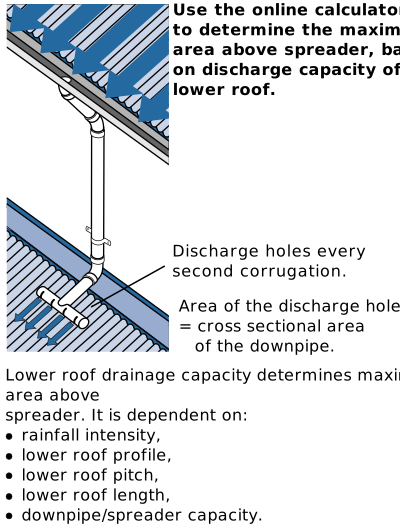
All downpipes that discharge onto a lower roof must have a spreader to dissipate energy and ensure wide distribution of the water. A spreader should be used over multiple troughs.
For corrugate, a spreader should not discharge into a lapped trough. When using the COP calculator, discharge may be into a lapped trough of a trapezoidal or a trough profile.
The area of discharge holes from a spreader should equal the cross-sectional area of the downpipe.
The 5.8.1 Maximum Area Above Spreader Calculator enables users to determine the maximum upper roof area that a lower roof can discharge for a given combination of rainfall intensity, roofing profile, and lower roof pitch.
Note that this site address is used only for convenience if printing calculations to attach to documentation. This address is not factored into calculations - you must determine intensity from Region/Location selection, Rainfall Intensity Maps or NIWA's HIRDS tool. The address is not recorded or shared with any other parties.
=IF ( ( h3 > 0) , ( W * cos ( C5; ) - 0.5 * h3 * tan ( C5; ) ) * h3 , 0 )
=( W * cos ( C5' ) - 0.5 * h4 * tan ( C5' ) ) * h4
=A1 + A2 + A3 + A4
=h1 / sin ( C5 )
=h2 / sin ( C5' )
=IF ( ( h3 > 0 ) , h3 / cos ( C5 ) , 0 )
=h4 / cos ( C5' )
=WP1 + WP2 + WP3 + WP4
=h2 * tan ( PI()/2 - C5 ) - IF ( ( h3 > 0 ), h3 * tan ( C5 ) , 0 )
=h2 * tan ( Beta - PI()/2 + C5 ) - h4 * tan ( C5')
=FWSW13 + FWSW24
mm
x mm
mm
Select Manufacturer (if applicable) and Profile
Describe the product: this does not control the calculation which relies on you entering accurate data
Pitch, or centre-to-centre measurement. Can also be calculated by (Effective Cover Data) ÷ (Number of Pans).
mm
Width of the pan.
mm
Calculated result from (Pitch) - (Crest).
mm
Width of the crest (top of rib).
mm
Total depth of profile.
mm
Depth of profile from the pan to the height of the capillary tube.
mm
Data provided by a manufacturer, especially for irregular profiles.
mm²
Data provided by a manufacturer, especially for irregular profiles.
mm
Data provided by a manufacturer, especially for irregular profiles.
mm
Data provided by a manufacturer, especially for irregular profiles.
mm
m²
m²
m²
m
m
mm
m
mm
mm
mm
mm
mm
mm
mm
m/s
m³/s
mm
This result is the maximum capacity that can be drained by an element of your selected configuration. Be sure to consider all relevant elements when assessing a roof area.
m²
This result is the maximum length of roof that can be drained by your selected configuration. Be sure to consider all relevant elements when assessing a roof area.
m
This result is the maximum area that can be drained above a penetration by your selected configuration. Be sure to consider all relevant elements when assessing a roof area.
This result is the maximum area that an upper roof area can drain using a spreader of your selected configuration. Be sure to consider all relevant elements when assessing a roof area.
m²
Conditions and assumptions for flat gutters:
Mannings n assumed to be 0.014 to represent long term friction conditions.
Equations valid for gutters with min gradient 1:500, max gradient 1:100.
Bends are accounted for by local loss coefficients (0.5 for each 90° bend).
Conditions and assumptions for downpipes:
Mannings n assumed to be 0.014 to represent long term friction conditions
Any grates must not restrict flow or site-specific design is to be completed - typically double the number of outlets
Gutters must have fall for downpipe sizing to be valid
Calculations consider weir, orifice and friction effects
Orifice discharge coefficient of 0.61 assumed
Weir coefficient of 0.65 and 75% of outlet perimeter assumed available for weir flow
Minimum pipe gradient of 20% assumed for friction conditions
Conditions and assumptions for valleys:
Mannings n assumed to be 0.014 to represent long term friction conditions
Minimum height of Type A valley returns to be 16 mm
Minimum freeboard of 20mm mm for valleys below 8°
Minimum freeboard of 15mm for valleys 8° and steeper
Conditions and assumptions for maximum run:
Mannings n assumed to be 0.014 to represent long term friction conditions
Only valid for supercritical flow (most roofs)
Conditions and assumptions for penetrations:
Mannings n assumed to be 0.014 to represent long term friction conditions
Only valid for supercritical flow (most roofs)
Where Both Sides selected, assumes an even split of flow to either side of penetration
Conditions and assumptions for level spreaders:
Mannings n assumed to be 0.014 to represent long term friction conditions