
It’s all about standards
Article for New Zealand Metal Roofing Manufacturers magazine 18 November 2016. Author Jayne McCullum
NZMRM works actively with Standards New Zealand and Standards Australia to ensure all building standards for our industry are developed and maintained correctly.
What do we know about Standards New Zealand? How does the standards process work?
About Standards New Zealand
We are New Zealand’s leading developer of standards and standards based solutions. Most of our standards are developed in partnership with Standards Australia. Our role is to manage the development process using internationally recognised best practices. The processes we use comply with directives from the International Organization for Standardization (ISO and the International Electrotechnical Commission (IEC).
What is a standard?
Standards are an agreed way of doing things. Standards provide potential solutions to issues, resolve problems, provide a means of compliance with legislation and create commercial benefits such as trading opportunities. A prime example of this is the freight container standard (ISO 668).
Once it was published, it enabled transport companies and container manufacturers around the world to order from the same set of specifications. Trucks could be built in America to carry containers manufactured in Korea. Having an international standard for containers enabled companies and countries unfamiliar with each other to join new markets and trade with confidence.
Standards are generally voluntary, but can be mandatory when cited in Acts, regulations, or other legislative instruments.
Who initiates the development of a standard?
A wide range of private and public organisations initiate and help fund the development of standards. In many cases these are industry bodies or government departments.
How is a standard developed?
Committee members who are experts in their fields draft the standard (or revise or amend an existing standard) and we manage the development process. We use a robust and recognised process that relies on expert committee consensus and widespread consultation with affected parties, including public input.
We have some of the best and brightest people within their fields serving on standards development committees. Their time, expertise, and knowledge are crucial to delivering standards solutions that are relevant and practical.
Why do we need standards?
Standards improve our lives in a wide number of ways.
- Standards help to keep our homes, buildings, playgrounds, and health services safe.
- They help to prevent accidents and injuries in a broad range of areas.
- Standards minimise the impact of potential disasters such as earthquakes, or fires and electrical hazards, and they improve the quality of goods and services.
- A standard can enable highly technical information, often needed to support policies or legislation, to be written into a document to aid understanding of context by users. An existing standard can help minimise unnecessary duplication, confusion, and inconsistencies.
What about standards and the building industry?
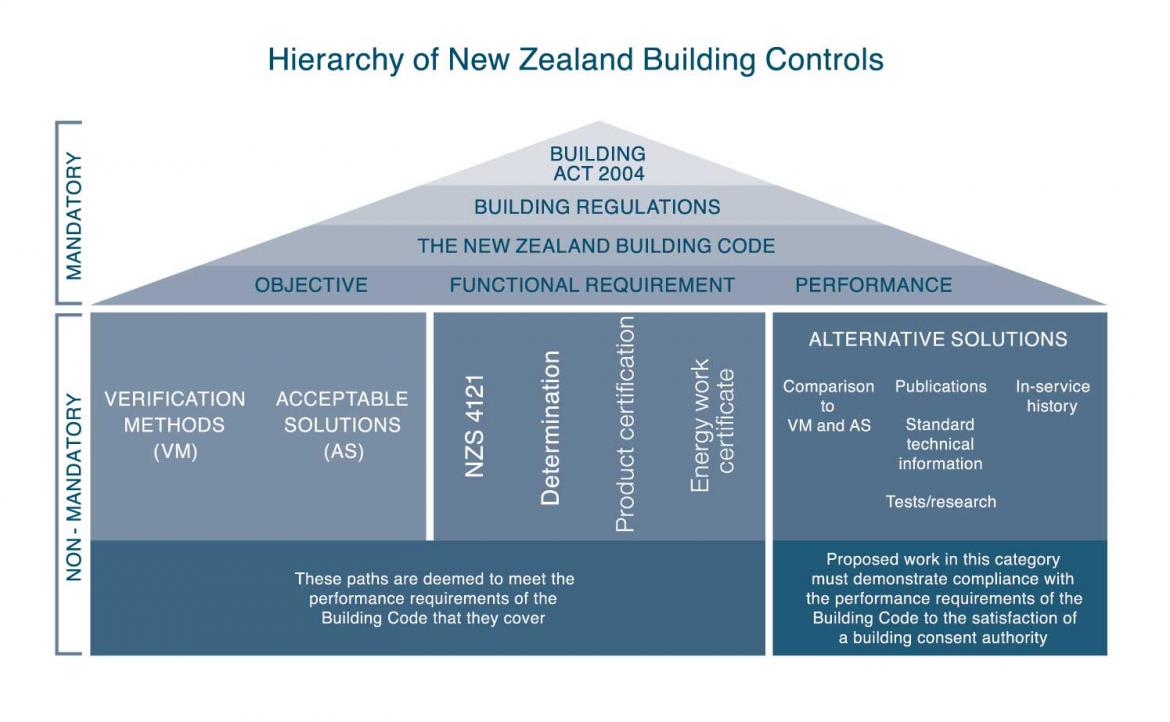
The New Zealand Building Code
- Acceptable Solutions – specific construction methods, some for simple residential buildings, that when followed are deemed to comply with the Building Code.
- Verification Method– methods of testing, calculations and measurements that when followed are deemed to comply with the Building Code.
Many buildings, particularly more complex projects or renovations, rely on alternative solutions to demonstrate compliance with clauses of the Building Code. This is where all, or part, of the building design differs from an Acceptable Solution or Verification Method, and other means are used to show how building work still complies with the Building Code.
Standards and other cited Acceptable Solutions and Verification Methods are not mandatory requirements for compliance with the Code. However, they provide crucial, practical guidance on how to comply with the Building Code in a cost-effective way.
NZS 3604:2011 Timber framed buildings is a good example of an Acceptable Solution to the Building Code. NZS 3604 is used to design most homes and other low-rise timber-framed buildings in New Zealand. It provides prescribed methods for the design and construction for timber-framed, low-rise buildings to meet the requirements of the Building Code without the need for specific engineering design. By limiting the size of the building and scope of application, NZS 3604 presents a series of solutions, enabling a designer to select an element or detail without having to engage a structural engineer.
The use of standards in the building and construction industry offers several advantages. These include:
- industry acceptance of New Zealand standards – standards have a long and proven history in the building sector and are recognised for their independence and integrity. In light of this, and the technical expertise involved, standards produced by Standards New Zealand have a high level of industry acceptance
- flexibility to encourage and support innovation – standards are useful as a means of ensuring a continued flexibility and responsiveness of prescribed methods of compliance with the code performance criteria
- standards incorporate current industry best practice through the committee development process. They are living documents open to review and amendment to reflect changes in technology and practice
- amendments to standards can be developed and published relatively quickly compared to the time frames for revising legislation. Standards are more flexible than regulations in responding to and reflecting industry trends and developments
- access to international standards and expertise – as well as drawing on experts from New Zealand or the development of standards, Standards New Zealand has access to international standards and expertise through our membership of ISO and the IEC.
Recent changes at Standards New Zealand.
Following a review of New Zealand’s standards and conformance infrastructure, the Standards and Accreditation Act 2015 came into force on 1 March 2016. This led to Standards New Zealand becoming a business unit within the Ministry of Business, Innovation and Employment.
We are part of the Consumer Protection and Standards branch in Market Services. We are led by the General Manager of Consumer Protection and Standards who was appointed as the independent New Zealand Standards Executive (the Standards Executive). The Standards Executive is responsible for functions formerly carried out by the previous Standards Council including managing the formation of standards development committees; the development of draft standards; reviewing and revising existing standards; taking responsibility for our membership of international standards organisations; reporting to the Minister on the standards work programme; and setting fees for New Zealand standards.
An independent statutory board – the Standards Approval Board – appointed by the Minister of Commerce and Consumer Affairs is responsible for approving the membership of standards development committees and standards that are developed by those committees. The Board meets once a month.
We continue to develop standards, support the work of our expert volunteer committee members to develop standards, and look to our nominating organisations to nominate committee members. We also continue to provide access to standards through our website www.standards.govt.nz
We would like your feedback on building underlays
Standards New Zealand and the P2295 committee are currently seeking feedback on the draft amendment to NZS 2295:2206 Pliable, permeable building underlays.
NZS 2295 is intended to provide practical guidance for manufacturers and importers of underlay material intended to be used in New Zealand, and for users specifying underlay to select the appropriate products.
The P2295 committee wishes to ensure that synthetic roof underlays introduced into the New Zealand market have properties appropriate to the range of conditions found in New Zealand buildings. The committee is undecided about whether the proposed new ‘retention of condensate test method’, or some variant of it, is the most appropriate means of ensuring condensation on the underside of the underlay is safely managed, at least for synthetic roof underlays.
You can view or download the draft amendment on the Standards New Zealand website. The closing date for comments is 27 January 2017.
Standards in the roofing industry?
“In fact much of what we do as manufacturers of metal roof and wall cladding, and rainwater goods is covered by a number of standards, NZS, AS and joint. This is not always appreciated by even our members and often not by users. This applies to the use in buildings as well, e.g. NZS 3604. NZMRM has been and is involved in a number of standards in both countries over the years. I plan one or more articles to talk about how standards do or should affect our industry and also what we have been doing on actual standards.
But to kick off this discussion we have the article above by MBIE/Standards NZ. Way back in Issue 16 - sometime in 2007 - we asked Standards NZ for an article describing how standards work, and it now, with the absorption of Standards NZ into MBIE (if this is the right term) we asked them for an update, and here it is. Thanks to the author Jayne McCullum for putting this together for us”.
Stuart Hayman