
Lichen And Mould
Lichen is a naturally occurring phenomenon with its spores being dispersed by the wind. Lichen will grow even on inert materials such as G.R.P., glass, and painted or unpainted metal roofs.
Time of wetness of a surface affects lichen and mould growth. Sheltered and shady environments are particularly conducive to its growth and although light-coloured roofs may stay wet for longer than dark roofs, it can equally proliferate in open areas on dark coloured roofs.
Lichen and mould retain moisture, are acidic, and have tiny roots that can penetrate a paint coating. Removal is necessary to prevent damage to the organic coating, but recolonisation is very likely. Where lichen has been treated, regular inspection should be undertaken to curtail spread of re-growth.
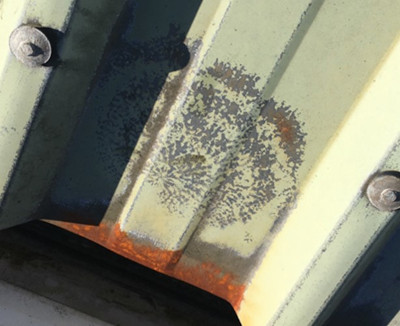
Lichen growth can be removed by washing down the roof or wall cladding, and applying a 2% solution of sodium hypochlorite to all surfaces by low-pressure spray, broom or brush. The surface should be left for 5 minutes but should then be rinsed and thoroughly washed down with cold water.
Household bleach and other products, such as liquid pool chlorine, contain various concentrations of sodium hypochlorite. Some commercially available moss and lichen removal products have different active ingredients, such as Benzalkonium Chloride or organic compounds.
Before using the table below, read the product label to confirm the active ingredient and the concentration of Sodium Hypochlorite in the product to be used.
Water/Bleach Ratio
| Water/source ratio for a 2% sodium Hypochlorite Concentration | ||||
|---|---|---|---|---|
| Product | Household Bleach | Outdoor Cleaner Concentrate | Liquid Pool Chlorine | Custom |
| 4.2% | 5.25% | 12.5% | 10 | |
| Desired Total Volume(L) | Source product required (L) | |||
| 4 | 1.9 | 1.5 | 0.64 | 0.8 |
| 9 | 4.3 | 3.4 | 1.44 | 1.8 |
| 10 | 4.8 | 3.8 | 1.6 | 2 |
| 12 | 5.7 | 4.6 | 1.9 | 2.4 |
| 20 | 9.5 | 7.6 | 3.2 | 4 |
| 50 | 23.8 | 19 | 8 | 10 |
- Log in to post comments